

How to grow a solar installation business in South Africa
What independent installers can learn from rent-to-own companies – without trying to become one
South Africa’s solar market is entering a new phase. The urgency of loadshedding may have eased, but competition has intensified and customers have become more selective about where they invest. Today, technical expertise alone is no longer enough: customers are comparing financing, service, professionalism and long-term value alongside the system itself.
Rent-to-own and subscription-style solar companies have been quick to respond to these changing expectations — and their success offers some valuable lessons for independent installers. The question is no longer simply how to sell more solar, but how to build a solar business that can compete, grow and remain relevant in a maturing market.
In 30 seconds:
- Customers have changed. They compare value, financing, service and trust — not just technical specifications.
- Large solar providers are reducing friction. Independent installers can learn from how they structure the customer experience.
- Your advantage is expertise + relationships. The opportunity isn’t to become a rent-to-own company. It’s to become a stronger, more specialised solar business.
Solar subscription providers simplify the proposition by leading with an affordable monthly cost rather than technical specifications. Source: GoSolr. Advertisement reproduced for illustrative purposes.

The solar market has changed
A few years ago, selling solar in South Africa was relatively straightforward. Loadshedding created urgency, customers were actively looking for solutions, and many installers grew quickly on the back of residential demand.
That market looks different today.
Customers are more cautious. They compare quotes more carefully. Financing matters more. And increasingly, rent-to-own and subscription-style solar companies are shaping customer expectations around what buying solar should feel like.
For many smaller installers, this raises an uncomfortable question:
Is there still space in the market for independent installers?
The answer is yes – but the market is evolving.
The installers who succeed in the next phase of the industry will not only be technically competent. They will also need to operate like professional businesses. Interestingly, there is a lot independent installers can learn from the companies currently growing fastest.
What customers value is changing
| Then | Now |
|---|---|
| Urgency | Long-term value |
| Technical solution | Complete customer experience |
| Upfront price | Affordability and financing |
| Installation | Installation PLUS ongoing support |
| Availability | Trust and professionalism |
Why rent-to-own companies are winning customers
The South African market now includes a range of financing-driven solar models. Some companies offer subscription-style services with maintenance included, while others focus on lease-to-own structures, financed ownership or long-term energy-service agreements. Although the details differ, they all aim to solve a similar customer problem: reducing the upfront cost and complexity of going solar.
For customers, that can make solar feel far more accessible. For installers, it signals something important about where the market is heading: customers increasingly value simplicity, predictable costs and reduced financial risk alongside technical quality.
Rent-to-own companies solved something many installers still underestimate: customer friction.
Most customers are not primarily thinking about inverter specifications, battery chemistry or DC protection. They are thinking about affordability, reliability, convenience and trust.
Instead of selling only a technical product, many financing-focused solar companies built customer journeys designed to remove friction:
- The onboarding is usually simple.
- The monthly cost is predictable.
- The communication is structured.
- Customers understand what happens next.
For many homeowners and businesses, that level of clarity feels safer than navigating multiple technical quotations from installers who all explain things differently.
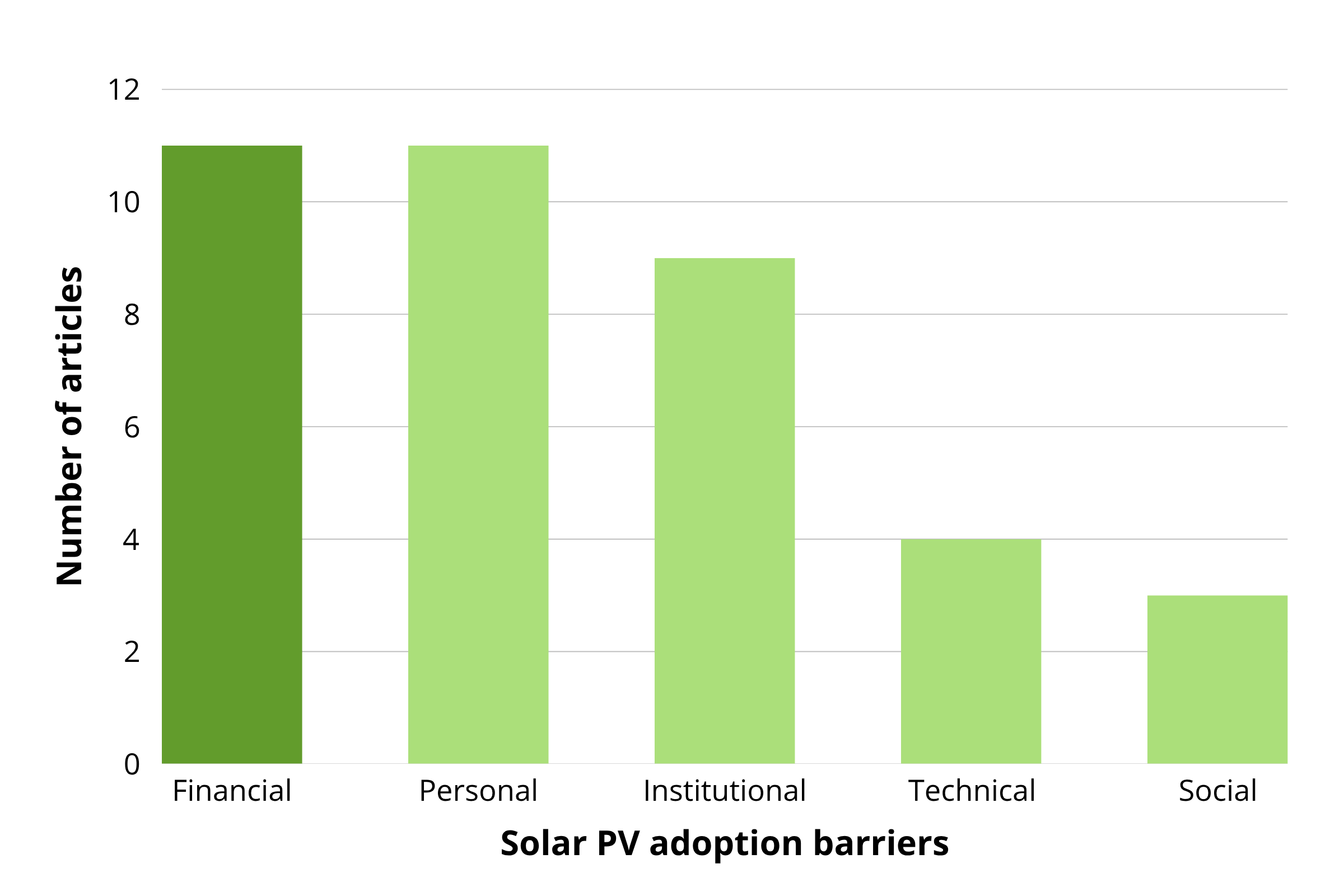
Financial and personal barriers were the most commonly identified barriers to residential rooftop solar adoption across the South African studies reviewed. Source: Mutumbi, Thondhlana & Ruwanza (2024), Heliyon.
That does not necessarily mean the large companies are technically superior. It means they recognised something important:
Professionalism has become part of the product.
This is one of the biggest lessons smaller installers should take seriously. In a more mature market, customers do not only judge the installation itself. They judge the entire experience around it.
Rent-to-own companies remove friction
Simple process
Customers understand what happens next.
Predictable costs
The financial commitment is easier to understand.
Clear communication
Customers aren’t left interpreting technical quotations alone.
Structured service
The experience feels organised from first contact onwards.
Professional businesses build more trust
Large rent-to-own companies are often highly process-driven. They typically have standardised quoting systems, customer follow-up procedures, clear branding and structured internal workflows. Independent installers can learn a great deal from this.
Many smaller solar businesses still rely heavily on informal communication, manual processes and reactive customer engagement. While this may work at small scale, it becomes increasingly difficult to maintain consistency as projects grow. And customers notice these things.
A professional quotation, clear timelines, organised documentation and regular communication already create confidence before an installation even begins. In many cases, customers interpret professionalism as a signal of technical competence, whether consciously or unconsciously.
This is especially important now that the market has matured. During peak loadshedding years, many customers bought quickly because they felt pressure to act immediately. Today, they have more time to compare providers, read reviews and evaluate reputations.
Trust and consistency matter more than ever.
What professionalism looks like before you even arrive on site
✓ A clear, easy-to-understand quotation
✓ Realistic project timelines
✓ Organised documentation
✓ Regular customer updates
✓ Clear next steps
✓ Reliable follow-up
Financing is no longer optional
One of the clearest shifts in the post-loadshedding market is that customers are no longer making purely emotional buying decisions. The industry is moving away from panic purchases and toward financially justified investments.
That changes the sales conversation completely.
Many technically excellent installers still struggle when customers ask practical financial questions. Customers want to know how long the payback period is, whether financing makes sense, what rising Eskom tariffs may mean over time, and whether the investment actually suits their consumption profile. Meanwhile, financing-focused solar companies have built entire sales processes around answering exactly those questions.
The questions customers are actually asking
“How long is the payback period?”
“Would financing make more sense?”
“What happens if electricity tariffs keep rising?”
“Does this investment actually make sense for my consumption?”
The lesson here is not that installers need to become bankers. But they do need to become more comfortable discussing ROI, cashflow, financing structures and long-term value. Customers increasingly expect guidance, not just technical information.
That is why financial understanding is becoming a real competitive advantage for installers. Courses such as our Solar Sales Expert and Financing of PV Systems exist precisely because the market is demanding a broader skill set from solar professionals.
Learning is a journey
PV GreenCard → Specialist skills → Business capability → Long-term success
One of the strongest ideas in GREEN’s training framework is the reminder that: “The GreenCard gets you into the market, but staying in the market is about skills.” That distinction is becoming increasingly relevant.
For many installers, obtaining the PV GreenCard still feels like the final destination. In reality, it is increasingly becoming the starting point. As the industry becomes more competitive, installers need stronger systems, deeper technical capability, better customer communication and clearer business positioning to remain relevant.
The PV GreenCard is the entry, not the goal
The market is slowly separating into two groups: installers who simply install systems, and installers who build sustainable solar businesses. The difference usually has very little to do with one certificate alone. It has far more to do with professionalism, specialisation, ongoing learning and the ability to build long-term customer trust.
Independent installers still have a major advantage
This is where many smaller installers underestimate their value.
Large companies are often excellent at scaling systems, financing and marketing. But they can struggle to deliver the kind of personalised relationship many customers still want when making a significant investment. Independent installers are often more flexible, more accessible and more accountable locally. They usually know the customer’s site personally, understand the installation history and remain directly involved long after commissioning is complete. That matters.
Customers aren’t necessarily looking for the biggest solar company. They’re looking for someone they trust to still answer the phone two years later.
That is not a small advantage. It is one of the biggest competitive strengths smaller installers still have.
Another important reality is that large-scale sales operations can sometimes become overly standardised. Systems are often designed around efficiency and repeatability, which makes sense from a business perspective.
But solar projects are not always identical. Customers with unusual load profiles, complex sites, difficult compliance requirements or long-term expansion plans often still need experienced installers who can think critically and adapt solutions properly. This is where technical depth becomes extremely valuable.
Installers who continue building expertise in areas such as compliance, commercial design, O&M, troubleshooting and system optimisation are positioning themselves far beyond “basic installation work.”
That is also why GREEN’s learning paths increasingly focus on specialisation after the PV GreenCard stage.
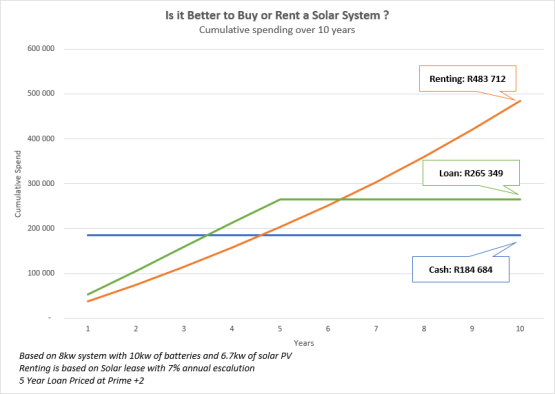
Lower upfront costs can make solar rental attractive, but the long-term cost picture changes over time. This example compares the cumulative cost of renting with owning an 8 kWh solar system. Source: LookSee / Standard Bank, via Moneyweb.
Where independent installers can win
Local relationships
You know the customer, their site and the history of their system.
Technical depth
Complex sites need professionals who can diagnose, think critically and adapt.
Flexibility
Not every site or customer fits a standardised solution.
Accountability
Customers value knowing who they can call when they need support.
The next opportunity is business maturity
The solar market is growing up. One of the most important lessons installers can take from larger solar providers is that long-term success rarely comes from relying on one-off residential installations alone.
The more mature businesses in the industry are building recurring revenue streams through maintenance, monitoring, compliance services, system upgrades and long-term customer support. This is already reflected in the way the industry is developing. As more systems are installed across South Africa, maintenance and operational support are becoming increasingly important.
The market is shifting from “Who can install solar?” to “Who can run a reliable solar business?”
That creates a major opportunity for installers who are willing to evolve beyond basic installations.
The future market will likely reward businesses that combine technical competence, professional processes, financial understanding, customer trust and long-term service capability.
The once-off model
Find customer → Install → Invoice → Find another customer
The long-term model
Design & install
↓
Monitor
↓
Maintain
↓
Upgrade
↓
Support
↓
Long-term customer relationship
The future still belongs to skilled installers
Rent-to-own companies are not the end of the independent installer.
In many ways, they are simply showing the rest of the industry where customer expectations are moving. Customers increasingly expect professionalism, simplicity, financing options and predictable service experiences. Installers who learn from that shift, while doubling down on their own strengths, still have enormous opportunities ahead of them. Especially those who combine strong technical skills with quality management, good customer communication, structured internal processes, ongoing training and long-term accountability.
Ultimately, large companies can standardise solar. But they cannot fully replace trusted professionals with strong technical skills, local relationships and personalised long-term support. That remains the installer advantage.
5 things to take back to your solar business
1. Reduce customer friction.
Make quotations, communication and next steps easy to understand.
2. Learn to discuss the financial case.
Customers increasingly want to understand ROI and affordability, not only system specifications.
3. Treat professionalism as part of your product.
Good communication, documentation and follow-up build trust before the installation even begins.
4. Keep building specialist skills.
Commercial PV, compliance, O&M and customer advisory skills can differentiate you from standardised providers.
5. Think beyond the installation.
The strongest customer relationship doesn’t necessarily end at commissioning.

What do you want to be able to do next?
Basic installation skills are only one part of a long-term solar career. As the market matures, installers can become more valuable by specialising:
Move into larger or commercial projects
Your next step: GREEN C&I PV Designer Certification
Improve regulatory and technical compliance
Your next step: Compliance for PV Systems / Solar Certificate of Compliance training
Build recurring maintenance revenue
Your next step: Operation and Maintenance for PV Systems
Improve system modelling and design capability
Your next step: PV*SOL design software training
Improve commercial capability
Your next steps: Financing for PV Systems and Solar Sales Expert
You don’t need to do everything at once. Choose the next skill that matches where you want your career or business to go.
At GREEN Solar Academy, we work with individual installers, growing solar companies and technical teams across the industry to help build the skills needed for long-term success.
Speak to Tsakani and the GREEN sales team about your company’s specific training needs and where your next growth opportunity may be.
